

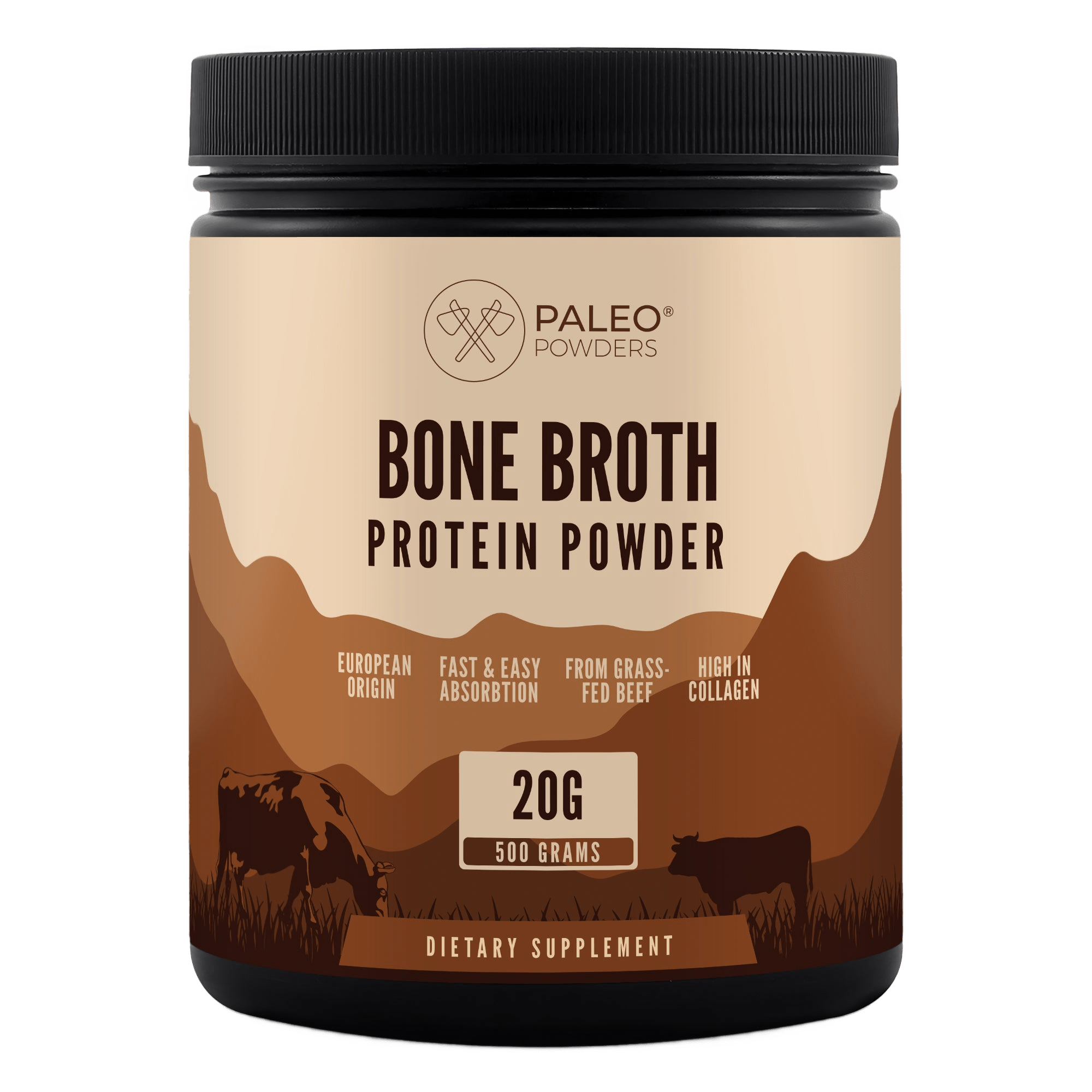


Bone Broth – 500 grams
Bone broth is a millennia-old soup made by simmering animal bones in water. Paleo Powders bone broth powder is made exclusively from meaty beef bones, including bone marrow, sourced from European grass-fed cattle. The broth is then carefully dried into a powder, creating a concentrated and highly nutritious collagen-rich product.
Rediscovering Tradition
Bone broth powder is easy to use, highly versatile, and fits perfectly into modern lifestyles while preserving the authentic nutritional value of traditional homemade bone broth. What was once a common part of the human diet has recently regained popularity. A serving of collagen-rich bone broth can be a valuable addition to daily nutrition. Here are a few reasons:
- Contains glycine, proline, and hydroxyproline
- Contains collagen types I, II, III, IV, and V
- Contains hyaluronic acid, glucosamine, and chondroitin
- Keto-friendly: 0 grams of sugar
- Free from dairy and plant proteins
- >95% protein per serving
- 100% European origin
- From EU grass-fed pasture-raised cattle
- Neutral taste
- 500 grams per jar
Why Is Bone Broth Worth Trying?
Collagen is the most abundant protein in the human body. It is an essential structural component of many tissues, from muscles to joints and skin. However, from around the age of forty, the body’s ability to produce collagen gradually declines. By the age of sixty, collagen production can be roughly 50% lower than in younger years.
The body’s own collagen requires proper nutrition and external stimuli to function and remain in optimal condition. This is true for all living and dynamic tissues. Collagen is rich in the amino acid glycine. From an amino-acid perspective, collagen balances muscle meat, which is rich in the amino acid L-methionine. Maintaining balance between these two amino acids is considered an important health parameter.
Bone Broth vs. Collagen
Paleo Powders bone broth has a mild, savory taste and mixes easily with liquids. Most of the collagen proteins in bone broth powder are not broken down (“hydrolyzed”) into small peptides. In collagen hydrolysate powder, the collagen proteins are hydrolyzed. As a result, most of the protein in bone broth remains intact (with a molecular weight between 8 and 20 kDa). For those seeking a less denatured collagen option, bone broth powder is an excellent choice.
Gelatin and collagen are similar but not identical. Hydrolyzed collagen is collagen that has been broken into smaller fragments. When collagen is cooked, it forms gelatin. Both contain the same amino acids but have different properties. You may choose one variation or combine both depending on personal needs, preferences, or specific goals.
Equally important is that a high-quality bone broth powder provides a broader spectrum of nutrients than most standard collagen hydrolysate supplements. In bone broth, collagen is denatured into gelatin, making it easier to absorb. Bone broth also contains a wider range of collagen types. Additionally, it naturally contains hyaluronic acid and other glycosaminoglycans (GAGs), including chondroitin and glucosamine. These components make bone broth a more complex product than collagen hydrolysate alone.
Difference Between Collagen, Bone Broth & Kefir Whey
| Collagen Hydrolysate | Bone Broth | Kefir Whey |
| Neutral taste | Mild savory taste | Creamy |
| Fast absorption | Normal absorption | Fast absorption |
| Hydrolyzed | Not hydrolyzed | Semi-hydrolyzed |
| Collagen types I & III | Collagen types I–V | No collagen |
| Enzymatically processed | Slow simmered | Kefir fermented |
| 95% protein | 98% protein | 90% protein |
| 95% collagen | 78–84% collagen | 0% collagen |
| No dairy | No dairy | Dairy whey |
| 0% fat | 2–5% fat | 0% fat |
| 0% sugars | 0% sugars | 0% sugars |
| Glycine 21.6% | Glycine 20% | Glycine 1.5% |
| BCAAs 7.42% | BCAAs 8.4% | BCAAs 23.75% |
| Hydroxyproline 10.6% | Hydroxyproline 10.2% | Hydroxyproline 0% |
| From bones | Meaty bones | Pasture milk |
| No glucosamine | Contains glucosamine | No glucosamine |
| No chondroitin | Contains chondroitin | No chondroitin |
| No hyaluronic acid | Contains hyaluronic acid | No hyaluronic acid |
Approved for Paleo and Keto
Bone broth protein powder contains only paleo-approved ingredients from responsible sources. It delivers the exceptional nutritional value of European grass-fed beef bone broth and provides nourishing collagen proteins that are largely absent from modern diets.
A well-made bone broth does not depend only on the cooking process. The quality of the ingredients is even more important. European grass-fed beef bones and clean Northern European groundwater are two key elements that make Paleo Powders bone broth effective. Meaty, marrow-rich bones release their nutrients into the pure groundwater during cooking, making them easily absorbable.
- Did you know that your body cannot produce the essential amino acids required to build collagen? This is why adequate daily intake is important.
- Did you know that due to its gelatin and collagen content, bone broth has a unique relationship with water? These compounds attract and retain water, something your digestive system can benefit from.
- Did you know that bone tissue is highly dynamic? Collagen in bone is constantly renewed and remodeled throughout life. Each year about 10% of bone tissue is replaced, meaning you effectively renew your skeleton roughly every ten years.
Bone Biology
Bone is a highly dynamic, mineralized connective tissue composed of osteoblasts, osteocytes, and osteoclasts. Bone quality benefits from adequate nutrition and proper physical stimulation, while poor nutrition and lack of stimulation can degrade bone structure. Bone remodeling is a complex process in which old bone is continuously replaced by new bone.
Mechanical loading is an important factor, especially in healthy and active lifestyles. The skeletons of our prehistoric ancestors often show very robust bones. Evidence from muscle attachment sites even resembles those of modern professional athletes.
European Grass-Fed Bone Broth
Paleo Powders bone broth is made from grass-fed, certified pasture-raised cattle. During the winter months, the cattle are still fed natural silage (fermented grass) or hay. Supplemental feed is only used when truly necessary to maintain optimal animal health. Because the entire production takes place responsibly within Europe, it is also a sustainable option.
Paleo Powders bone broth protein powder is an excellent choice for those who prioritize quality, sustainability, animal welfare, and environmental responsibility.
The Importance of Quality
Not all bone broth protein powders are the same. The quality and origin of the ingredients are essential when making a choice. Protein products derived from collagen-rich tissues such as bones can contain traces of unwanted chemicals, including heavy metals. Responsible sourcing and sustainable farming practices greatly reduce this risk.
Quality control, product safety, and transparency are top priorities for Paleo Powders. Every certificate of analysis is carefully reviewed, and each new batch is double-checked for heavy metals in an external laboratory. Typical values include:
- Arsenic (As): less than 0.10 mg/kg (less than 0.1 PPM)
- Cadmium (Cd): less than 0.01 mg/kg (less than 0.01 PPM)
- Mercury (Hg): less than 0.005 mg/kg (less than 0.005 PPM)
- Lead (Pb): less than 0.05 mg/kg (less than 0.05 PPM)
Homo Soup-iens
Waterproof and heat-resistant cooking pots were invented only about 5,000 years ago. For a long time, it was believed that soups and broths only became common between 5,000 and 9,000 years ago. Recent archaeological findings have revised this estimate. Cooking vessels suitable for soups were already in use around 20,000 years ago.
There are also indications that our ancestors may have prepared soups even earlier without pots, using pits lined with animal hides or stomachs. Heated stones could then be placed into the liquid to bring it to a boil. The steam caused the stones to crack—an archaeological sign that appears roughly 25,000 years ago.
Other soup-cooking techniques may be even older. For example, animal skins filled with water could be suspended above a fire. The water prevented the skin from burning while the contents inside heated and eventually boiled.
For at least 25,000 years, soups and broths have therefore been an important and nourishing food source. Only in relatively recent times has broth become less prominent in the daily diet, which also reduced the intake of collagen and related amino acids.
Bone Broth: A Powerful Ancestral Soup
Research suggests that bone broth is one of the most nutrient-dense foods available. After simmering, the broth contains an abundance of amino acids and other nutrients. Making it at home is time-consuming and not always practical, as the cooking process is slow and high-quality bones are not always easy to obtain.
Bone broth is nevertheless one of the foods that can be recommended for regular consumption. It even fits within the strictest paleo lifestyles. All ingredients meet essential paleo quality standards: grass-fed cattle, dairy-free and lactose-free formulation, and double testing for heavy metals.
The products of Paleo Powders combine ancient nutritional wisdom with modern knowledge and innovation. This European bone broth provides all the benefits of traditional broth without the effort of home preparation, delivered in a convenient powder form suitable for shakes, smoothies, or creative recipes wherever you are.
Content
Instructions
Ingredients
Choose options